Salman Rashid
The Soon Valley: quiet, secluded glens, thickly wooded with phulai (Acacia modesta) and sanatha (Dodonea viscosa) where the air rings with the call of the koel and the raucous arguments of Indian tree pies; where the lakes, if the season is right, abound with migratory ducks from the frozen marshes of northern Asiatic Tundra; where one can simply lose oneself in a wilderness of hill and forested glen within minutes of wandering away from any village; where clear rills tumble over bleached limestone and where it is still possible to surprise fox cubs frolicking in the thickets.
Such is the magic of the Soon Valley, part of the Punjabi highlands of the Salt Range and known to so few. The dilettantes that do know the Soon and feign to write about it will spell it Soan putting the knowing traveller somewhat off course. While the Soan (pronounced Swaan with a nasal ending) is a river that rises in the Murree hills, sweeps past Islamabad and Rawalpindi, skirts the north-western edge of the Soon valley at a respectable distance and dumps itself into the mighty Sindhu River near Makhad town, it has nothing to do with Soon Valley whose name is pronounced exactly as the English word.
The Soon Valley has many secrets but the one it has kept the best certainly is Kunhuti Bagh. If you dined with, say the Cabinet Secretary in his home in Islamabad in April or May and the dessert included freshly picked Washington Navel or Spanish Valencia oranges, you could be certain they had not been shipped in from across the oceans. This fruit was the pick of Kunhuti Bagh, making the orchard the only producer of off-season citrus fruit in the entire country. But this lasted until about ten years ago.
Official word on the orchard is virtually non-existent and so there is a tale. Kunhuti was some deputy commissioner who set up this garden for his pleasure and gave it his name, so the uninformed local ‘historian’ will tell you. But district records divulge that it was back in 1926 when a certain Major Whitburn, the District Engineer, carried out a survey to select a site for an orchard in order to experiment with non-local citrus varieties. Two things went in favour of this site, first, the climate. At 700 metres above the sea even its hottest summer is yet mild in comparison to the rest of Punjab. Secondly, a copious stream runs through this wild forest which could easily be harnessed for irrigation.
As for the name: a quick run through the list of deputy commissioners of Shahpur district (having since ceded the honour to first Sargodha and then Khushab), there was no official whose name even remotely sounded like Kunhuti. It is a purely local name.
Seventy acres were earmarked for the orchard and plantation began in 1933. Before the decade was over, the Kunhuti orchard was yielding first class Valencia and Navel oranges. That was not all, however. There were peach, apricot, pomegranate and mango trees as well that yielded a goodly harvest.
Things went well until partition and then Kunhuti went the same way as everything else we inherited from the Raj: down the tube. Until the end of the 20th century, the orchard was in the keep of the District Council. With steadily fading interest the council kept it trundling along and was making a meagre income from the annual crop. Then, in 2003, the orchard changed hands to become the responsibility of the Agriculture Department. That, according to one official, rang the death knell for Kunhuti. To begin with, the staff was by and by reduced to just two gardeners: for a garden spread over seventy acres these were scarcely adequate.
Not surprising then that the plantation begun so ambitiously by well-meaning colonial officials has fallen to less than half of its original area. Even so, the remaining trees are mostly diseased. The acreage abandoned by the forest is slowly being encroached upon by wild growth and taking the shape of rank forest. Better this than the area being turned into farmland or, worse yet, built up.
Back in 1990, the first time ever I visited Kunhuti, there were still the two species of orange trees that the orchard was celebrated for. And if one were to go by the gardeners’ report at that time, the District Council was making money auctioning the crop. Ambitious plans were afoot to utilise a small hill within the orchard and experiment with other species of fruits including cherry. One could see that the masters of the orchard were serious for they had laid out a gravity irrigation system to hock the water of the stream up the slope without the use of electricity. Now, seventeen years later, there are no Valencia or Navel oranges, having all died off. Of the many mango trees just one remains. Though trees of other species are still there, most yield very little fruit because of lack of care. Indeed, the pomegranates seen in late August were all blighted and hung shrivelled to the trees.
They only good thing to happen in this once fairy tale garden is the restoration of the old rest house. I do not have a date for its original construction, but it seems to go back to the 1940s. Back in 1990 it had a caved-in roof and I had felt it would soon be pulled down. This time round, the roof was redone, but the interiors of the three rooms were bare. One could at least be thankful for the small mercy of restoration.
Sadly there is no plan to re-introduce the lost species that once did so well in the balmy climes of the Soon Valley. The gardeners reflect the state of disinterest of their department for they could not be bothered about going the extra mile to procure Valencia or Navel saplings from a nursery an hour’s bus ride away. All they do is sit about gossiping and collect their salary at the end of the month. As for the Secretaries Agriculture, both provincial and federal, they may not even know Kunhuti exists.
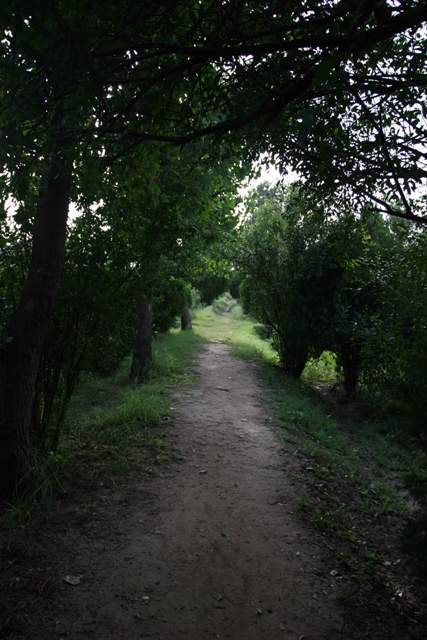
Although the charm of sampling rare species of oranges in the dry heat of May is gone, yet the nine kilometre drive northward from Khabeki village by the lake of the same name in the heart of the Soon Valley is dramatic. The road winds around hills with deep gorges on the side and strangely shaped buttes rising from the valley floor in a landscape that seems utterly devoid of other human presence. Then suddenly, one is confronted with a tree-lined pathway and in the background the off-whitewashed rest house building.
Though the fruit trees are nearly all but gone, Kunhuti still is a lovely sylvan retreat where the birds sing with the abandon they know only in a pristine forest and the lovely rill still flows pure and untainted. If for nothing else, one must, once in the lifetime, take the nine kilometre-long road for the birdsong.
 Fellow of Royal Geographical Society, Salman Rashid is author of several books including jhelum: City of the Vitasta and The Apricot Road to Yarkand, Riders on the Wind, Between two Burrs on the Map, Prisoner on a Bus and Sea Monsters and the Sun God. His work - explorations, traveling and writings - appears in almost all leading publications.
Directions: Get off M-2 at Kallar Kahar and take the road south past Padhrar. At Pail More you turn west for the Soon Valley and the village of Jaba. At Jaba turn south the road goes to Khabekki past the turning to Kunhutti. You are likely to miss the turn to the right as you head for Khabekki. There is actually only one turn to the right. Don’t forget to ask for directions. Bhadon (monsoon) is the best time to visit when the clouds are beautiful.